Category Archives: Uncategorized

This is (not) a school

This is part 3 of a series on String Theory Performing Arts Charter School in Philadelphia. I did a basic history of their massive 2013 bond issuance here. Then I analyzed a 2020 issuance here.

Last time, I dug around String Theory Development Corporation’s 2020 bond issuance to see what it was all about. This time, let’s get to some more amazing details of it as an apparatus: the entities involved and how they relate to one another.

There are a ton of characters in the drama called String Theory Development Corporation. The main characters are the DeMedicis and ‘the Corporation’.

Let’s start with the Corporation.

This is (not) a school

Technically, the Corporation refers to String Theory’s Performing Arts School. But confusingly the corporation is also the non-profit controlling the school. And thus also not the school.

While there isn’t anything to the Corporation other than the School, for legal purposes the School and Corporation are different. But they’re also the same. The way the issuance puts it:

The Corporation was incorporated in 2000 and operates as the public charter school known as Philadelphia Performing Arts: A String Theory Charter School (the “School”)

So the Corporation operates as the school, but is different than the school. I’m laughing right now over my keyboard. The School both is and is not a Corporation.

Where’s String Theory in all this? It’s actually a third thing that provides academic and business services to the Corporation for the School.

The Corporation has entered into an Academic and Business Services Agreement dated June 20, 2011…by and between String Theory Schools (“String Theory”) and the Corporation, pursuant to which String Theory provides academic and business services to the Corporation for the School.

In other words, “The Corporation relies on String Theory for all aspects of operation of the School.” So the corporation operates as the school but isn’t the school and also relies on String Theory for all aspects of operating the school.

Right.

Financially, this means that “the Corporation pays to String Theory a total annual fee of $2,253,562.50 for the 2020-21 school year, increasing year-over-year to $2,468,187.50 for the 2023-24 school year.” So the Corporation, which operates as the school, pays String Theory, its business services provider, millions of dollars to operate the school. Which both is and is not the Corporation.

It’s a late-capitalist postmodern mereological wonderland! And it only gets better. What about these DeMedicis?

Closer and closer apart

The DeMedicis are two non-profit corporations (DeMedici and DeMedici II) located in New Jersey whose sole reason for existing is to acquire and lease buildings to String Theory.

Sidenote: can you believe they’re actually called DeMedici? Like the Renaissance ruling class Italian family?

Lorenzo de' Medici - Wikipedia

I digress. How do these DeMedicis relate to the Corporation (which is and is not a school)? Bond issuances are long, but they’re very repetitive. One paragraph repeated multiple times throughout this one is:

The Corporation does not exercise corporate control over DeMedici or DeMedici II, but there is certain common membership across the boards of directors of the Corporation, DeMedici, and DeMedici II. DeMedici and DeMedici II are legally separate from the Corporation, but are component units of the Corporation for purposes of financial reporting.

You guessed it: the DeMedicis are both component parts of the Corporation (for financial reporting purposes) but are not part of the Corporation (for legal purposes).

Financially speaking, these things are all connected to one another. Legally speaking, they’re separate.

LOL.

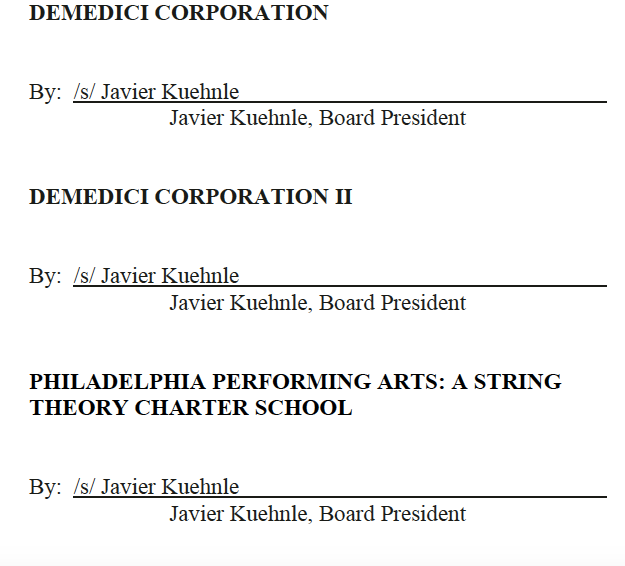
Indeed, Javier Kuehnle is president of all three: DM, DM2, and the School (which both is and is not the Corporation).
So what’s the practical relationship here?

As I wrote about last time, DM is the Corporation’s landlord. DeMedici, which both is and is not part of the school, leases some of the buildings to the Corporation, which, both is and is not the school. DeMedici II acquires and leases some facilities as well.

The DMs are also borrowers. They borrow the money from PAID (who is borrowing it from an anonymous cabal of ruling class people).

Here we have the basic parts of the String Theory Development Corporation, which aren’t really parts of anything but are also all the same thing: a set of corporations that are both component parts of each other and also separate from each other, that are a school but also not a school, acquiring, leasing, and using real estate with/to/from/for each other. And borrowing money from other people.

Of course, they’re not doing this for fun. The postmodern mereological wonderland of this arrangement has very a meaningful purpose: to maintain non-profit status and tax-exemption for everyone involved.

I’ll get to that in a moment. Before I end this section, I want to introduce the ensemble of minor characters in the String Theory Development Corporation drama.

Supporting characters

To get into this complex formation for the bond issuance, all the parties entered into something called an indenture, which is sort of like a guarantee for the bondholders. That indenture needs a Master Trustee, someone to oversee the whole affair. The U.S. Bank National Association, which is a subsidiary of US Bankcorp, is the Master Trustee.

Also on the bondholder side, Truist Securities, Inc. is the Underwriter, or the entity that purchases the bond. S&P Global Ratings assigned a rating of “BB+” to the Series 2020 Bonds, which is actually pretty high compared to the district itself, whose bonds get rated just above junk at BBB.

Don’t forget about the lawyers. Legal counsel is Ballard Spahr, a well-known corporate law firm in the region, and charter school finance experts Sand & Seidel are involved. Then there’s the PAID board:, Evelyn F. Smalls Chairperson. David L. Hyman, Esquire Vice Chairman, Thomas A. K. Queenan Treasurer.

Let’s look at the String Theory Governing Board. I’ve mentioned a couple of them but here’s the whole list and some of what they do. Here’s the composition:
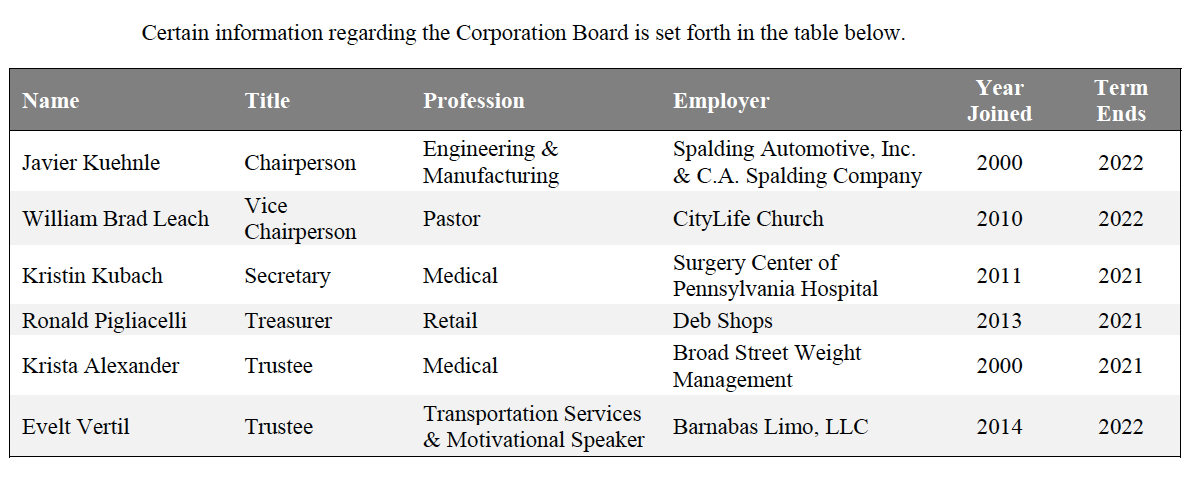
Their bylaws are interesting. Each member serves a two-year terms (without limits, I think). They’re elected by a majority vote of the existing board, so it’s very insidery.

Plus, any potential Corporation Trustee must be chosen from the slate of nominations set forth by String Theory Schools. So not only must the existing board vote for you, but you can’t even be a candidate unless String Theory (which provides the business and academic services for the Corporation which is and is not the school) approves you.

Very democratic! Also, this board controls the school. Make no mistake about their power.

Finally, our friends Santilli & Thomson, LLC, serve as business manager, not just on this deal but to the School in general. Let’s spend a moment with them, since they’re super proud of the school district revenge fantasy they’re enacting in the city. Also, previous reporting said that it’s not clear what S&T does or how much it makes. The issuance tells us both.

First, it says that S&T is the Corporation’s (thing that is not a school but also a school) business manager. They provide the Corporation “with certain accounting, budget, financial reporting, cash management, payroll, and other financial services.” How much do they make on this arrangement?

S&T makes $191/student on basic and fiscal officer services. The issuance says that in 2020-1, the school had 2,641 students. That’s $504,431/year for those services. They also claim “certain additional charges,” so I’m thinking it’s a bit more as well.

All these characters make money on the cost of the bond issuance, which is almost $1.5 million. If you can believe it, all of this non-profit and tax exempt. I’ll go into that next time.
String Theory Development Corporation

I went down a significant rabbit hole trying to understand a Philadelphia charter school bond issuance last week. It almost ended me. I was reading it before passover seder. I couldn’t stop myself from reading it when Thisbe our ten-month old woke me up crying one night. I tweeted a lot.

I think I finally came to some understanding about the Philadelphia Authority for Industrial Development’s (PAID) limited offering memorandum on a nearly $53 million bond it issued last year.

Here’s a post breaking down some of the news in this issuance, as well as what we should call this Performing Arts Charter School. I did so much writing I’m going to need at least three or four more posts, so buckle up.

(I may need to take a little break after this since I’m starting to feel the sadness Bruce Baker talks about when spending a lot of time thinking about school funding.)

The news

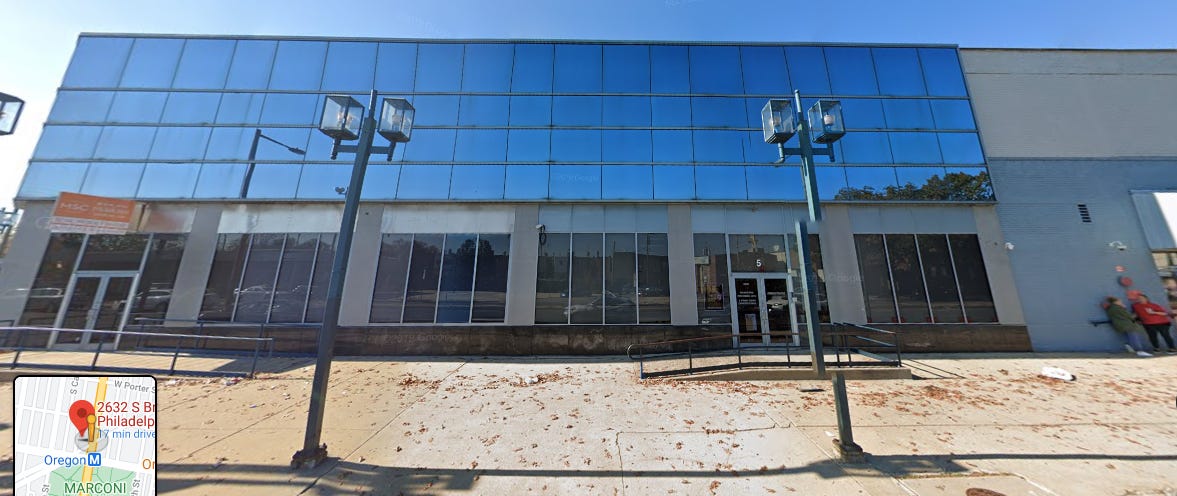
Every bond issuance has news. The news in this issuance is that ‘String Theory’, or the swarm of entities (dis)connected to it, is acquiring another property at 2632 South Broad Street. It’s going to renovate the building and use it for elementary education. They’re borrowing $6,147,211.38 for the acquisition and $1,507,278.01 for renovation.

But that’s just $7,654,489.39. The issuance is for nearly $53 million. What’s the other $45 million going to?

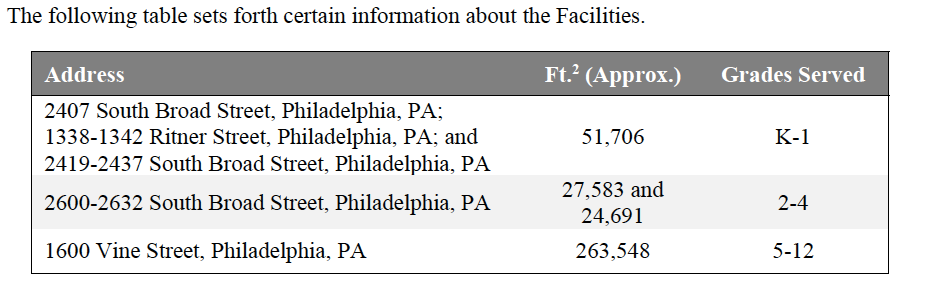
I’m not entirely sure. What I know is that ‘String Theory’ —which, again, doesn’t just mean a school but also a pseudo-school district/corporation that’s formed around it—is adding 2632 South Broad Street to its list of real estate holdings, for which it is still in debt. It already owns 2630 South Broad next door, for instance, as well as three other properties on Ritner Street and Vine Street

The biggest of these is the old GlaxoSmithKline building on Vine Street where the high school and middle school are. They’re now expanding the elementary school on Broad. All these properties together constitute a ‘project’ worth about $64 million. To acquire Vine Street, ‘String Theory’ had to take out what was, at that time, the biggest loan to date for a charter school in Philly history.

This 2020 bond issuance is partially to take out a loan for the new property, like I mentioned, but it’s also to take out another loan to pay back the loan ‘String Theory’ took out to buy Vine Street in 2013.

But actually it’s not that simple.

This loan—bare with me—is (I think) to pay back the loan that PAID took out on ‘String Theory’s’ behalf in 2013, and which PAID maybe paid back partially, which means that ‘String Theory’ needs to pay PAID back for it. But ‘String Theory’ doesn’t have that kind of money, so PAID is taking out another loan for ‘String Theory’ to pay PAID back for the 2013 loan (in addition to the new loan for the new acquisition).

Got it?

One person, Javier Kuehnle, controls this project and all the money flowing to and from it. His name is attached to all the (dis)connected but essential parts of the apparatus developing this real estate. I talked a bit about him in a previous post on the 2013 issuance. He sells specialty car parts and looks like this:

Javier Kuehnle - Chief Executive Officer - Spalding Automotive | LinkedIn

This deal works out well for everyone involved because interest rates are still really low. It looks to me like this is also a kind of refinancing of the original 2013 bond, whose interest rate was 8%. This loan’s getting half that rate at 4%. Thanks Federal Reserve! Cheaper money!

I think, anyway! I’m not 100%.

Again, the news is that ‘String Theory’ is engaged in a real estate development project, controlled by Javier Kuehnle, now worth over $63 million in Philadelphia. In 2020, they borrowed more money to add to their footprint in the city and help them pay back some of the money they’ve borrowed to do it, all for half the interest rate.

String Theory Development Corporation

Let’s pause. I don’t like writing ‘String Theory’. How should we talk about this thing called String Theory Philadelphia Performing Arts School that engages in all this real estate development?

I know charter schools have a chip on their shoulder about being ‘just like’ public schools and not being corrupt or shady. Instead, they’re good schools run by good-hearted people trying to ensure educational excellence by providing families with a choice of where to send students.

But come on. Let’s be real. This ‘school’ is a real estate development corporation.

It’s not a typical real estate developer, in the sense that it has an educational mission and, as it goes out of its way to demonstrate in painful repetitive detail in the bond issuance, everything is non-profit. But, as I’ll show later, it is not publicly controlled though it receives significant public funds.

Of course, the people behind this development corporation need to go to these lengths because all their moves and holdings—including the interest payments on the loan they’re getting from an anonymous ruling class cabal—are tax-exempt. And if things go south for String Theory, Javier Kuehnle becomes the owner of the property, which certainly isn’t a good look. I’ll go into this later.

The question right now is what do we call ‘String Theory Performing Arts School Philadelphia’. It’s certainly more than a school.

So let’s call this thing String Theory Development Corporation.

I think it fits into the broad category of oppressive-exploitative arrangements with which some groups with more power steal resources from others through complex apparatuses.

A charter school development corporation is particularly impactful in this sense, as it draws money away from district schools that serve disproportionately more high-need populations, keeping a tax-exempt status and not facing regulations. It’s a way of acquiring and controlling capital without regulation, in this case commercial real estate.

The bond issuance is an essential source of information about how String Theory Development Corporation works and its legal, political, economic, and cultural place in the larger Philadelphia social formation.

Next time, I’ll get into that.

School district revenge fantasy

The amazing Dr. Camika Royal gave a lecture on her research to my program recently. She’s an historian of urban education focusing on Philadelphia and has a book coming out soon. Look her up!

She mentioned that, while researching her book, she found herself reading the minutes of school board meetings from the 1960s, and when she got to the parts about funding she got frustrated—what does this stuff mean? That’s the work I’ve been doing recently, and I asked if she had a sense of any important bond issuances from the minutes she’d been reading.

She and another colleague mentioned a $55 million bond issuance in 2013 that enabled String Theory Charter Schools to purchase a corporate office building on 1600 Vine Street. Reporting at the time called the bond the “largest in the city’s history.”

I haven’t tried looking into charter school finance yet, mostly because I knew it would make me really mad, but also I wanted to wait until I understood the basics of traditional public school finance before wading in. No time like the present!

So here’s a rabbit-hole type post about one case of charter school finance. If you want to read some good research on this, check out Daniel M. Cohen and Emily Rosenman’s work.

Also, I can’t get the song Beauty School Dropout out of my head. Charter school finance has the same phonetic rhythm.

Beauty School Dropout by Floozi Boyz

Charter review

There’s been good reporting on this issuance in the Inquirer. I’m hoping to lift the lid on this String Theory financing deal and detail the players more, do some demystification, and hopefully learn more about charter finance in the process.

Remember that charter schools are tax-funded and nongovernment-operated. Of course, charters still issue bonds to fund all sorts of ‘capital projects’, which I put in scare quotes because, when it comes to charters, these capital projects can just be a way for nongovernment charter operators and their affiliates to get tax-exempt loans to buy and develop real estate.

When public schools issue bonds, school districts take out loans to develop and maintain public property. Sometimes state governments do it. But when charter schools issue bonds, it’s not always clear who exactly is issuing the bond. Lots of other groups get involved.

Take the case of Philadelphia Performing Arts Charter School, managed by String Theory Schools. In 2013, they purchased and moved into GlaxoSmithKline’s former national headquarters. Who was involved in this deal?

The school needed a loan to buy and fix up this building, so they issued a bond. But it wasn’t actually String Theory that did the deal. It was a whole turgid cloud of financial entities. I kind of want to call it a ‘murder’ of entities, like a murder of crows, but that’s an insult to crows.

What I found was nothing less than a miniature semi-private school district-like blob that governs the finance and administration of this single charter school. This quasi-district isn’t accountable to the public through elections or even appointments.

Let’s take a look at the players.

The DeMedicis

First up is DeMedici Corporation II (DM2), a non-profit company based in New Jersey. DM2’s stated goal is to “TO OWN AND LEASE SCHOOL FACILITIES TO NOT-FOR-PROFIT SCHOOLS.”

Okay. They’re described in reporting as an affiliate to String Theory, but they’re listed technically as a subordinate organization of the Performing Arts Charter School itself, almost like a facilities finance department. Their most recent 990 tax forms report more than $4.4 million in receipts.

It also looks like their three executives only work one hour a week and don’t get paid any money to do so. The guy who signed their tax forms is DM2’s listed President, Javier Kuehnle, this guy, the CEO of Spaulding Automotive, a company specializing in specialty car parts. Indeed, Kuehnle the Chair of String Theory’s board.

The Vice President of DM2 is Ronald Pigliacelli, who is String Theory’s treasurer and is the Director of Import Operations for Deb Shops, a women’s clothing retailer. DM2’s secretary is Krista Alexander, a professional funeral services director.

You might be wondering a lot of things. Why is DM2 the second DeMedici Corporation? Is there a first one? Indeed, DM2 is different than DeMedici Corporation, but they’re also similar. DM1 is located at the same address as DM2. They’re also a nonprofit corporation. I can’t find anything else about DM1.

School district revenge fantasy

But DM2 didn’t actually acquire the building. The firm Santelli and Thomson (S&T), whose entire reason for existing is to consult on charter finance, was the firm that acquired the building, which they announced on their website. Founded by two former Philly school district officials, it’s projected to be making millions of dollars every year.

The Inquirer reporting on this, as always, is quite good. As of 2015, there’d been a corruption case brought against S&T but no one was found guilty. No one really knows what they do but they have a big staff and big reach.

But it seems likely that String Theory exists because Gerald Santinelli met Angela Corosanite at a School Board meeting in the 1990s. Corosanite, a ballet teacher, was there to propose an after-school program. Santinelli suggested she apply for a charter. S&T became close partners of the school.

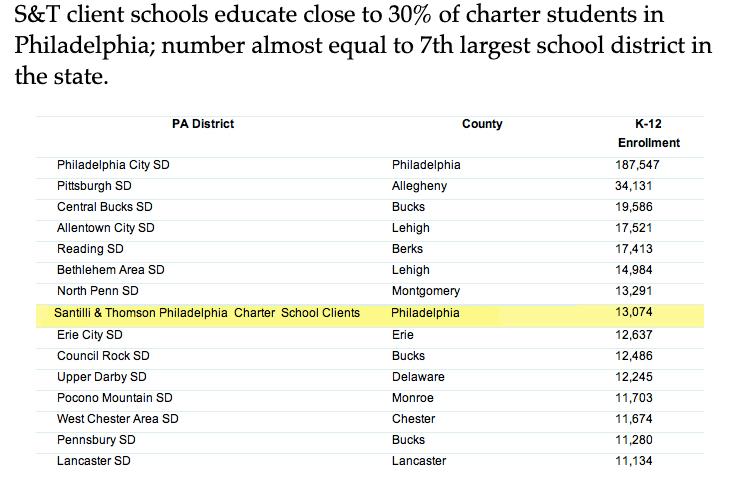
S&T is interesting since they like to boast of the number of students their client schools educate. At this point, they’re bigger than a lot of school districts in PA. Given that they were founded by former district officials, it makes sense that they would think of themselves as a district, like in this graphic on their website.

So rather than a school district owning and leasing school buildings, a private firm does. I bet Santinelli and Thomson had some kind of libertarian revenge fantasy against the Philly school district. Just my guess. What they ended up doing was recreating their own district without any of the safeguards or democratic processes of traditional districts, very shadily.

George and the Authority

But S&T doesn’t do the underwriting, or actual issuing of the bond. George K. Baum & Company (GKB) does, as the investment banker Jason Appelt discussed the sale alongside Jason Corosanite from String Theory (the brother of Angela, I’d guess). GKB was recently acquired by Stifel Finance Corporation, the announcement of which tells us a bit about the firm:

Founded in 1928, GKB is headquartered in Kansas City, Mo., and maintains 24 offices nationwide, including public finance offices in 22 cities. The firm has consistently ranked as a leading underwriter and financial advisor in many areas of the country including Colorado, Kansas, Missouri and Utah and has strong nationwide practices including housing, higher education and independent schools.  Since 2000, GKB has provided underwriting or financial advisory services to more than 7,796 municipal bond issues totaling more than $320 billion.

But also, you can’t really say that GKB issued the bond, because the entity that filed the bond issuance itself was the Philadelphia Authority for Industrial Development. Their acronym—get a load of this—is PAID.

PAID is a public authority incorporated by the City of Philadelphia and organized to undertake three main activities. PAID is a vehicle through which PIDC manages properties and industrial sites on behalf of the City including property acquisition, improvement, environmental remediation and/or sale. PAID also issues taxable and tax-exempt bonds on behalf of non-profit organizations, qualified manufacturers, other exempt organizations, and the City of Philadelphia. PAID serves as a conduit for governmental contract and grant program funding for economic development projects throughout the City. 

On the bond issuance itself, PAID is the entity issuing the bond. GKB consults on this issuance. PAID loans the money to DM2, who acquires the building. S&T consult on the DM2 side. String Theory is the center of the entire ring. I think?

I’m just renting to myself

How does all this work together? What actually happened in this bond issuance?

Let’s not forget this is a municipal bond issuance. Profits on interest and money going back and forth are tax exempt in Pennsylvania. So a lot of people are making a lot of money.

PAID issued a bond for the DeMedicis, who are both separate and not separate from the school. They acquired the building and continue to lease it to the school. They’re also paying out fees to consultants like GKB and S&T.

Let’s think about the school and the DeMedicis. According to the issuance, the school does not exercise corporate control over DM1 or DM2. They are legally separate. But they have common members across all their boards. Also, the DeMedicis are legally separate from school. But they are “component units of the corporation for tax filing purposes.” Lol.

Wigglesworth and Briggs say that String Theory, through DM2, “effectively “rents” its building from itself, collecting $188,000 a year through the state’s Charter School Lease Reimbursement Program.” Auditor General Eugene Pasquale called this a circular arrangement where the school creates different entities that acquire the building and then lease the building to itself.

The funniest part of all this: school districts do all this stuff, but in a way more streamlined, democratic, and scalable way. Districts lease property, acquire and maintain property, and issue bonds—except they do it for everyone using property taxes.