Category Archives: Uncategorized

WTF is local school funding

Schools get funded two ways: grants and loans. I wrote about Yonkers school district’s recent bond issuance, focusing on a recent loan they took out. Carlos Burgos, who’s running for City Council there, mentioned that a constituent was wondering where the money for schools went.

Loans like the bond issuance are only part of the story. We should look at the grants also, which come from taxes.

Yonkers City recently passed a budget that funds the district with almost $270 million. The entire school budget is something to the tune of $700 million. Where’s that money coming from?

Well, two places. Yonkers only gets 38% of its school funding locally. That comes from local property taxes in the city budget. A pretty sizable 56% comes from New York state. So we have to look at the New York State budget too.

This time, let’s focus on that 38% of the local budget contribution. There’s more than enough to chew on there.

Before we get started

This whole thing can be very overwhelming. Maybe you’re not super into municipal finance. Maybe your eyes glaze over when when thinking about budgets and taxes. Before we get started on Yonkers’ local contribution to the school budget, how about we cover some basics first.

A tax is when an arm of the repressive state apparatus scoops out some money from capitalist production and spends it on something.

Schools in Yonkers, like schools pretty much everywhere in the United States, are funded through property taxes, specifically real estate: buildings, houses, land, etc.

If you own property, you pay a tax to the local and state governments, who take the money and direct it to the school district as part of the budget. (This direct connection to real estate, one of the most important forms of capital, is what makes school funding so interesting to me as a socialist.)

But that’s a very simple portrait of a gloriously complex quanty-mathy-awful process. When trying to find a metaphor for the experience of understanding this tax process, the image I keep coming back to is having a skeleton’s fingers in my brain (which is how a famously acerbic German philosopher once described reading the modern philosopher Immanuel Kant — I can confirm this is similar).

Bones Hand GIF - Bones Hand Brain - Discover & Share GIFs

But this terrible sensation is part of the feeling of state power. So we have to let the fingers into our brains because we want the world to be better. We have to understand this stuff. Here we go.

There’s so much involved! To tax property we need numbers: prices, rates, and formulas. To tax the property, the government has to assess its value. Then it has to decide how much to tax that assessed value. That rate is called the millage rate, or the number of dollars taxed per $1,000 of assessed value.

Note, this doesn’t mean the price of the real estate on the market, or its market value. Assessed value is not what the property might go for if you wanted to buy or sell it. Rather, the assessed value is a number the government comes up with that takes into account features of the property, neighborhood, uses, exemptions, and an assessment rate. In a nice illustration of the line between base and superstructure, the assessed value is actually lower than the market value.

In Yonkers, City government assesses property value, sets the tax rate, and collects the taxes to allocate a certain amount to the schools. All of this has to follow state and federal law.

Let’s start with who’s who in this whole business.

Who’s who: assessors

There are usually a bevy of committees, commissions, and groups at both the state and local level who officially determine what the value of property is and how much to tax it. Many of these groups are led by elected officials, their staffs, and appointed officials. Let’s see who’s who in Yonkers property value assessment.

In Yonkers, the city government has an Assessment Department devoted to this task. The Assessment Department is part of the Department of Finance and Management Services, whose commissioner is John Liszewski. Here’s what he looks like:

John_Liszewsk_Pose71i

But he oversees the whole finance department. When it comes to assessing property taxes, that falls to the City Assessor. According to a trifold I found (since it’s not listed on the website), that is David B. Jackson. Here’s Jackson being sworn in recently for another six-year term.
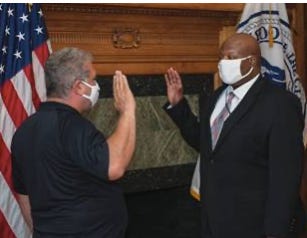
Mayor Spano said of Jackson that his “extensive experience in assessment administration allows us to continue to build on our efforts in providing Yonkers taxpayers with a fairer and more efficient assessment process.” What’s Jackson’s background?

He’s a property tax bureaucrat who’s been in finance departments for awhile, working for the Westchester County Tax Commission (which oversees tax assessment and collection, but doesn’t levy any taxes itself) and doing finance department stuff in Norwalk, CT and Washington, DC. He was president of something called the New York State Association of County Directors of Real Property Tax Services, a group of people who have power over property taxation in New York.

He was also super active with the International Association of Assessing Officers in DC and Connecticut, the “global leader and preeminent source of standards, professional development and research in property appraisal, assessment administration and property tax policy.” Looking at Jackson’s LinkedIn profile, he’s been overseeing the assessing of property value for a very long time.

Before we look at the numbers themselves, let’s look at who these assessors are assessing. Which properties in Yonkers get assessed?

Who’s who: the assessed

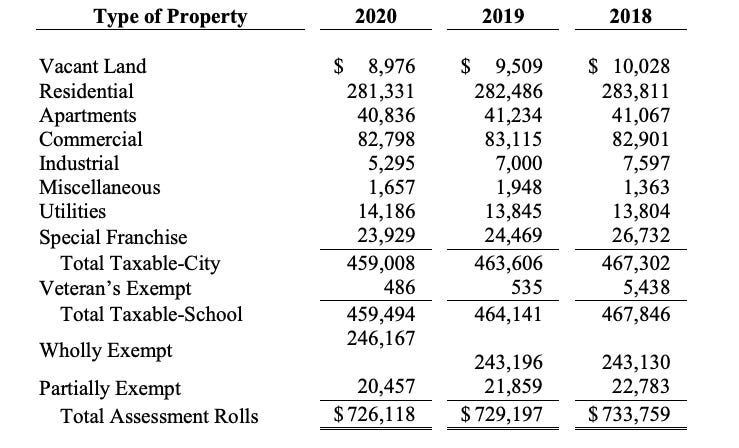
According to bond issuance, as of November of last year, Yonkers has more assessed residential property than commercial, industrial, and apartment real estate combined. Residents—home-owners—are paying a lot of these taxes to fund schools. But there’s a significant commercial and industrial tax base too.
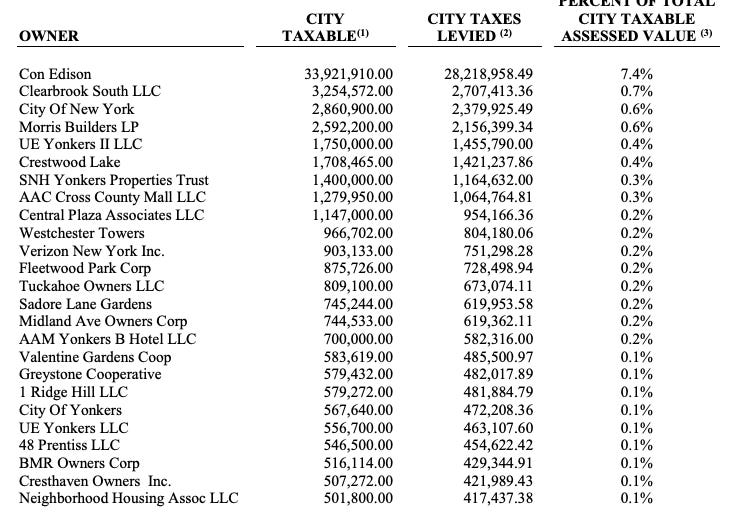
When it comes to the commercial and industrial real estate in Yonkers, let’s look at who’s got the property that’s being taxed. You can see below that Con Edison, the largest investor-owned energy company in the US, has real estate that makes up 7.4% of the city’s taxable assessed value, orders of magnitude more than any other large real estate tax payer. So while the residents pay a lot of the taxes, the largest payer is Con Ed. The next largest is Clearbrook South LLC (which seems a little weird and is something I want to look into).
The revenue

So we know who’s assessing. We know who’s getting assessed. Let’s look at the assessments themselves and the rates at which the City is taxing all this property for school funding. We can find that information in the budget.
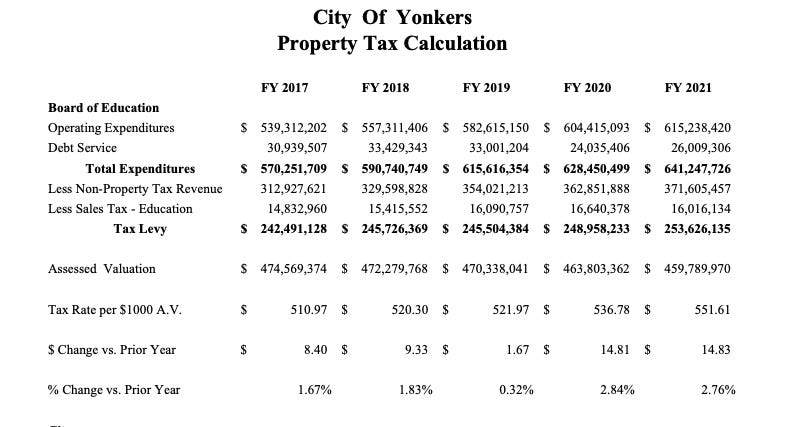
You can see in the ‘tax levy’ part of this chart that the amount the Board of Education is taking from taxes is around $254 million from an assessed valuation of almost $460 million. The millage rate is $551.51 for every $1,000 of assessed value, which is more than half and has been increasing since 2017.

If you really want to, you can go through the rolls of properties and check their assessed value and tax contributions. Here’s one document that’s almost 4500 pages long.

Local means assessment and millage

Well, there it is: local property taxes are the result of value-assessment of different kinds of real estate by a bureaucrat, the determination of a millage rate to tax them at, and then the collection of taxes for the budget.

I think the difference between assessed and market value is interesting from a socialist perspective, and of course it’s good to put faces behind these ambiguous apparatuses. If I were a leftist running for office, I’d wonder about connections between Jackson (though he seems on the level), Liszewski, and exempt properties. I’d wonder about ConEd and its role in the city as well. I’d wonder about certain neighborhoods and their parcels’ property values, if any are increasing/decreasing more than others.

But I’d also wonder about the state budget, which I can write about in the future if it’d be helpful!
Yonkers’ bad neighbors

I mentioned before that I was going to focus on a school district I know very little about. That school district is the Yonkers City School District.

I’m doing this for a couple reasons.

As I said, I’ve wanted to focus on a district I don’t know about; maybe to test my chops and maybe to get out of the Pennsylvania context for a bit and try to examine a school district and capitalism in a different region.

I’m focusing on Yonkers specifically because a friend of mine Carlos Burgos is running an insurgent left campaign there for city council. He’s trying to unseat a conservative Democrat and he said it’d be nice to see some analysis of the district. I’ve also been working with Jamaal Bowman’s office on school funding, and Yonkers is right in Bowman’s congressional district.

I have two things I can offer. The first is a bond issuance analysis. This is basically me reading the district’s most recent bond issuance to find important bits of information about debt, but also flows of power in the district’s political economy. I published a piece of that analysis on Monday.

The second is more ambitious and experimental. It’s a form of analysis that places Yonkers in its regional context, specifically the extent to which there is material cooperation across and between it and the districts that surround it. I call it cooperation analysis, but it’s also an attempt to measure racial-capitalist exploitation between school districts, with an eye towards policy interventions.

Cooperation Analysis

‘Cooperation analysis’ describes a way of understanding inequity in a region of school districts bordering on one another. While resources like EdBuild and others have done crucial work to map these inequities, this is a more interactive framework. To what extent are the districts cooperating? Are they sharing resources, or are they adversarially/individualistically taking what they can get? To what extent are they oppressive and exploitative (or as Esther Cyna would say, kleptocratic)?

If districts distribute resources well across such differences, there is a high cooperation level. In such cases, those districts with groups who historically have structurally benefited from racial capitalism are allies (low cooperation) or accomplices (high cooperation).

If resources are distributed poorly, there is low cooperation and some amount of oppressive exploitation. In moderate to extreme cases, districts with more structural benefits are oppressive exploiting other districts.

I have a methodological appendix below, but basically this index is an expression of the standard deviations and averages in a number of measurements: percent nonwhite students, per pupil spending, percentage of students in poverty, percentage of students on free/reduced price lunch, number of students, median household income, median property value, percentage of local revenue, percentage of state revenue, percentage of federal revenue, debt service, and student-teacher ratio.

The overall cooperation level is measured in basis points, or hundredths. Anything over zero is non-cooperative. Anything over 500 is extremely non-cooperative, or oppressively exploitative.

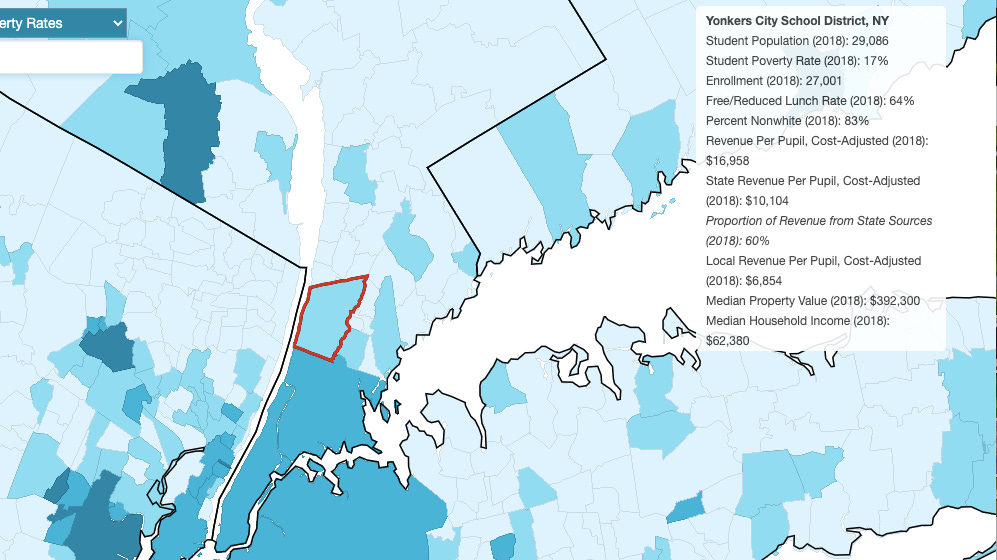
When it comes to Yonkers, let’s look at the other Westchester school districts bordering YSD on its north and east (since the river is to the west and NYC is south). I’ll use EdBuild’s Dividing Lines maps with 2018 data and 2019 NCES data. There are seven districts to consider: Yonkers, Eastchester, Hastings-on-Hudson, Ardsley, Edgemont, Mount Vernon, Tuckahoe, and Bronxville districts.

Here’s what I found:

  • This region’s school districts are extremely non-cooperative, with a score of 721.
  • Yonkers and Mount Vernon struggle with seriously oppressive exploitation viz. the other five districts.
  • Hastings-on-Hudson, Ardsley, Edgement, Tuckahoe, Eastchester, and Bronxville districts are neither allies nor accomplices in fighting this oppressive exploitation.
  • When it comes to specific measures, the most egregious instances of oppressive exploitation are in number of students, avg students with free/reduced price lunch, and debt service. If the oppressor districts took on some of the burden in these categories, the region could become more cooperative.

Here are two recommendations for socialist/left-progressive local and national politicians (city council and congress in particular) based on these findings:

  • Messaging around regional cooperation at both local and national levels is essential when it comes to school funding. We’re all in this together. It’s not a dog-eat-dog world of resources, state government in NY is maxed out and the federal government tends to be hands-off.
  • Yonkers City Council issues bonds on behalf of the school district, as I’ll write about in another post. Leftist electeds should consider pushing for solidarity bond issuances where nearby districts with low debt, high property value, and high credit scores take out loans in partnership with Yonkers to share the debt burden and cooperate on capital projects. Local and national voices would be key in this initiative.

One thing I’m interested in after this analysis are millage rates in this region. They’re so different that I couldn’t average them together and I’m wondering why. For instance, Yonkers school district’s millage rate is 551.6 per every thousand dollars of assessed value. But Bronxville school district’s rate is 14 mills, absurdly low comparatively. I imagine this is because its average property value is a whopping $1.13 million.

Yet Bronxville SD is technically part of the Town of Eastchester (along with Tuckahoe SD). Tuckahoe and Eastchester SD’s millage rates are absurdly high comparatively, at 1525 and 1596 mills respectively. What’s going on here? How are some districts part of townships under the umbrella of town governments, while others aren’t?

Here’s the data I’m working with and my calculations. Below are a couple appendices. For the next part, I’ll do a bond issuance analysis.

Background demographics overview

Historically, the Yonkers City School district is, like so many districts, the result of a consolidation from the 1880s. Many consolidations got off the ground with bond issuances where multiple schools agreed to take out a loan together and build a school. This is what I mean when I talk about solidarity bonds. Such a bond happened in Yonkers in 1881.

The district is situated in what was the Lenni Lenape territory stolen by European colonizers, bordering north of New York City School District, part of Westchester County, just south of several districts that fit more with what you might think when you hear “Westchester”: wealthy white suburb. Yonkers is an ‘inner ring’ suburb (some actually call it the ‘sixth borough’ of NYC), betraying the clumsiness of the suburb concept.

It’s a big district. As of 2019, there are 27,012 students. 39 schools. As of 2018, there is 17% student poverty. Guess how many of those schools have a Title 1 classification, which means they meet the national threshold for receiving extra funds for concentration of poverty? All of them.

While New York tries to compensate for this with progressive spending, it ultimately can’t overcome the oppressive exploitation at the local level. The power of the property values and demographics in the region are too much.

What does this poverty look like exactly? A full 20% of district’s families aren’t in the labor force. Nearly 30% of families receive food stamps. 64.3 % of families rent their homes. More than a quarter of their education stops after high school. Most recent median household income is $57,947 and median property value is $334,400, which maybe don’t seem low but take a look at the neighboring districts and you’ll see.

Looking at some racial demographics, do you know what I’m going to say? The district is majority of color. 58% Hispanic and 18% Black. No other district (except Mount Vernon perhaps) has the same percentage of nonwhite students.

Yet it’s important to take a strengths approach rather than reify or essentialize this diverse working class district as lacking in agency, oppressed, etc. The district is doing very well. According to a recent bond issuance that I’ll read more closely for the second post in this series:

The Yonkers 88% on-time graduation rate for 2019 exceeds the Statewide graduation rate by two (2) percentage points and Yonkers is the first and only Big 5 cities school district to achieve an 80% graduation, accomplishing this consecutively for four (4) years.

This is great stuff, and teachers, students, staff, administrators, and families must be working super hard to pull it off given the structural uphill battles they’re fighting.

Cooperation Analysis Appendix

Here’s how cooperation analysis works. It’s rooted in my previous research on the politics of classroom discussion.

Imagine a discussion in a small group. The space of discussion is like a resource: when we get together and talk we can think and reach new ideas, decisions, etc.

When it comes to sharing the resource of that space, participating cooperatively in the discussion means listening and speaking to one another so no one dominates. We can measure this by saying that non-domination occurs when each participant takes the floor an equal number of times. No one is taking the floor more than anyone else, everyone is listening and speaking. In a perfectly cooperative discussion, each participants’ number of turns taken is identical. They share the space they create together.

No discussion is like that, however. In most discussions there are people talking a lot, some people not talking at all, and everyone in between. Perfect cooperation is an ideal. So when I’m teaching participants how to achieve better cooperation, we can measure how far each of them is from the average: how much more do you have to listen and speak to be cooperating better? These are individual cooperation scores. What’s the group’s overall distance from the average number of turns? That’s the overall cooperation level.

When we do a material cooperation analysis, rather than participants in discussion, it’s entities participating in political-economic activity like, say, school funding across difference. Instead of individual people talking to each other, we have school districts taking in and spending revenue to educate a certain student body. There’s a certain amount of provisions available in the region and they’re all using it, like in a discussion. School district funding is social, interactive, and connected (no matter how much localism tries to ignore this structural fact.)

Here’s how I calculate the index: I put together data points for each of the measures for each district. I find the standard deviation for each distributions. Then I divide the average of these data points by their standard deviation. I then average each of ratios together into an overall number. Anything over zero is non-cooperative.

There’s still many questions and kinks I’m working through in this analysis. Ones on my mind right now are:

  • Should the ‘percent nonwhite’ category be disaggregated to include different racial categories? I’m presuming that the formation is white supremacist, so percent nonwhite would reflect that dynamic. But perhaps taking it apart into Black, Latinx, AAPI, etc would be better.
  • I need to generate a better profile of regions. How does Yonkers stack up against the Philly region, eg? Relatedly, I’d expect in states with policies that have attempted to equalize funding that certain regions therein would be more cooperative (with lower scores on the index). I’m thinking of the Twin Cities region, for example. Is that right? I need to compare.
  • What is my case that these measures are enough like a discussion (interactive/relational) to advance the analysis?

A Response to Hudson-Miles’ Review of “Gold and the Dross”

Richard Hudson-Miles of Kingston College, London wrote a detailed, insightful, and engaging review of The Gold and the Dross. It appeared in Pedagogy, Culture, and Society.

Backer’s book is intended as a short-form introduction to Althusser for those who have never encountered his thought before (Backer 2019, xii). It also is written in a style which deliberately tries to engage these unfamiliar readers, using anecdotal recollections to explain key Althusserian concepts. For example, the author’s childhood classroom admonishments and barroom romances in adulthood are invoked to explain ‘interpellation’. As the readers of this journal will recognise, relating complicated concepts to students’ socio-cultural spheres is a tried and tested method of pedagogy. Outside of the classroom, the orality of this style will engage and alienate in equal measure. However, a strength of Backer’s book is that each of these anecdotes is juxtaposed with unedited excerpts from Althusser’s texts, allowing the reader to test Backer’s subjectivist interpretations against the evidence of the text.

In addition to this praise (by which I’m quite honored) Hudson-Miles raises several important points that I’d like to address here, particularly since I’m in the final stages of that more technical manuscript on Althusser and education. He points to three ways my book is problematic: baggage, style, and confused Althusserianism. I take each in turn.

Baggage

In terms of baggage, Hudson-Miles recognizes my intention with G&D was not to do an exhaustive and in-depth study of Althusser’s legacy.

It should be highlighted that Backer promises a ‘longer, more technical manuscript on Althusser’s influence on educational thinking’ (Ibid.) in 2020, which should complement the present volume well. Given this, perhaps it is beyond the remit of this book to engage with the Althusserian legacy in depth, and unfair to criticise the author for this absence.

Indeed, that was my intent: not to weigh down readers with the important but circuitous and ultimately hard-to-understand historical conditions around Althusser’s thinking. Of course this context is important. But I’ve found that it proves a significant barrier to entry when engaging with the ideas themselves. Gold tries to ease that barrier.

But Hudson-Miles is clear-eyed about this very presumption. It is highly problematic to engage with Althusserian ideas themselves without acknowledging the context. Indeed, I recognize the importance of studying this context in the book but, to Hudson-Miles, I only “briefly discuss this problematic inheritance in the introduction (xiii–xvi). The result is that the author’s enthusiastic metaphorical explanations could be interpreted as uncritically pro-Althusserian.”

Being ‘uncritically Althusserian’ is a bad idea for many reasons. Althusser murdered his wife and comrade Helene Rytman. He was a member of the French Communist Party, which lost support for sticking with the Soviet Union throughout the postwar period and not backing the actions of May 1968. Intellectually, the theory has been somewhat debunked by a several generations of intellectuals on these and other grounds.

Hudson-Miles’s brief but extensive overview of these arguments and historical points is helpful for me as I prepare my manuscript, since I deal with many of these issues in my book. I lay out my thinking on how to read Althusser given the murder. I examine the intellectual history of Ranciere and Thompson’s critiques, with an eye towards understanding how Althusser was taken up in American critical education (via British sociology and cultural theory). I also examine their arguments and put forward my position on them (a preview of which appear in a forthcoming Critical Education essay).

In advance of the book, here are some reflections on the project as a kind of teaser but also in response to Hudson-Miles.

Style

Hudson-Miles elaborates these historical and intellectual vectors in the typical style of scholars of French and left thinking from this period. A dense series of interdisciplinary citations, phrases, and references are arrayed into large block paragraphs with just as much punctuation as words. The style is scholarly, but in the medieval as well as the academic sense. There is an attempt to cover everything, to put everything together, to make sure no detail of theory or its context or the various positions at play gets left unmentioned.

This style is typical of Althusser scholarship in particular. I’m not entirely sure why. There’s the influence of Althusser himself, both in terms of his actual style (dense) but also the commentaries on Althusser that emerged in England and elsewhere at the height of his influence. Those commentaries sought to delve into the problematic of Althusser’s writing, its historical context and its argumentation, with a kind of frenetically exhaustive precision–as if the fate of the Left depended on whether an author revealed the right sliver of thinking or history.

While it may very well have been true for leftists in that moment, their time has long passed. So I use a different style when writing and talking about Althusser. This choice could warrant an essay unto itself.

In brief, I think one thing that philosophy of education can offer the wider world is a pedagogical approach to philosophical arguments and concepts. We can cover philosophies in ways that make them more conducive to people learning them and studying them. I do that with Althusser. I do not go into every nook and cranny of context and commentary, but rather limit analysis to my project., which is both intellectual and political. Again, I detail this more in the book (particularly in the conclusion).

In fact, Hudson-Miles is so preoccupied with the ‘baggage’ and ‘style’ of my book, that he doesn’t engage with my rendering of Althusser’s actual philosophy! This is perhaps the most disappointing part of his review, as I would love to know what he thinks about my understanding of the laws of dislocation, uneven development, and social formations–which are the cornerstones of Althusser’s thinking.

Like so much scholarship on Althusser, the concepts get lost/overlooked in the tangled performance of explicating their context. This tangle betrays a sort of inconsistency of praxis when it comes to critiques of Althusser from the Rancierian angle. Ranciere scholars–and Ranciere himself– can sometimes focus on expounding the theoretical-historical importance of the equality of intelligence in their scholarly writing such that the basic insight of what it means to assume that equality when writing is somewhat lost. Indeed, it was difficult for me to read Hudson-Miles’s review. By the end of all the references, explications, and citations I still didn’t know what Hudson-Miles thought of my rendering of Althusser’s theory for educators, which was the purpose of the book.

Not Althusserian?

There’s an Althusserian case to be made for doing this as well, which is to say that concepts and philosophy are relatively autonomous from their historical context. They have their own temporality and it is possible to write in a mode of that temporality that shifts more towards the concepts without fully betraying or ignoring their context.

Of course these ideas emerge and are embedded in their problematics. But I think Althusserian scholarship has shifted more towards that embeddedness and in process lost focus on the power of the concepts and their historical importance. Hudson-Miles thinks is isn’t quite Althusserian (though notes encouragingly that my style might be infinitely more preferable than others).

Again, Hudson-Miles is right to point out that this is problematic. It could be seen as uncritically pro-Althusser, not in the sense of concepts, but in the sense of letting Althusser the man off the hook for murdering Helene and bad politics.

As I say in my forthcoming book, I take a dialogical-internal approach to this question. The personal and political context matter but the ideas also have a kind of life of their own that get lost when only focusing on the external conditions in which they were produced.

This is a slippery slope and maybe lets criminals and systems of oppression off the hook. I have tried to navigate this tension. For me the decision to engage with Althusser’s ideas in their relatively autonomous temporality has been worth it. I have found that these ideas have been helpful in the clarificatory project of critical education, helped in uncovering a tradition of international and diverse educational research that Althusser inspired, and has also been a touchstone for me as I organize in socialist and socialist feminist movements.

I do not let Althusser off the hook, but I do not keep him on it exactly–at least to the extent that his concepts are helpful for understanding the history of critical education, the lost tradition of structural education, and organizing against exploitation and oppress in the 21st century. I leave it careful and thoughtful readers like Hudson-Miles to decide whether I’m successful.